The budget changed the maths
For the best part of three decades, the default Australian wealth strategy was simple: buy an established house or apartment, gear it negatively, accept a yield of two or three per cent, and let the capital gains discount do the heavy lifting at the end. The May federal budget took both of those props away, no CGT discount, no negative gearing on established homes and at a moment when interest rates, land tax and insurance were already making residential investment expensive to hold.
James Thomson’s Chanticleer column in the Australian Financial Review on put the consequence bluntly. Two of the most experienced people in Australian property, Morgan Stanley’s Tim Church and Charter Hall’s David Harrison both expect a housing correction larger than the early-1990s slump, with Church putting the fall at as much as 15 per cent peak to trough. That is a serious call from people who do not make them lightly.
But the part of the column that should interest anyone who owns, leases or is thinking about buying commercial property was not the housing forecast. It was what happens to the money.
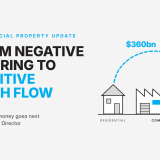
Harrison’s point is one of scale. Roughly $3.6 trillion is tied up in Australian residential investment property, and most of it is held not by institutions but by individuals, the dentist with two units in Richmond, the retired couple with a townhouse in Bentleigh. If just 10 per cent of that money decides it would rather earn a positive return than carry a loss for a tax benefit that no longer exists, that is around $360 billion looking for a new home.
Commercial property is the obvious destination, and it is walking into a supply squeeze in every sector:
• Retail. Shopping centres are close to fully leased and almost nothing new is being built.
• Office. The pipeline of new prime CBD towers is thin, after years of ‘work from home’ headlines scared developers off.
• Industrial. Cushman & Wakefield’s Noral Wild estimates about 520 hectares of industrial land across Melbourne and Sydney has been lost to data centres and other uses, and that is not coming back.
Harrison’s conclusion is that rents keep rising, quite possibly faster than inflation, which more than compensates for the drag of higher bond yields. Thomson’s broader argument is that tax reform, expensive debt and structural undersupply have lined up to produce a generational reallocation of capital, one the government did not set out to engineer.
GrayJohnson has been selling and leasing commercial property in Melbourne for 112 years, so we have watched a few of these shifts play out. The early signs of this one are already in our inbox.
The enquiry has changed. Since the budget, a noticeable share of the buyers calling about small industrial units and suburban retail strips are first-time commercial investors. They are often selling, or thinking about selling, a residential investment, and their opening question is: what is the net yield after outgoings? Six months ago, that question came from accountants. Now it comes from the dentist.
Sub-$3 million is where the action is. This is the price band that individual investors and self-managed super funds can reach, and it is where competition has tightened fastest. Well-leased assets with a national or long-standing tenant, a lease of five years or more and sensible outgoings are attracting multiple offers. The same asset with a vacancy or a short lease is still finding buyers, but at a price that reflects the work.
Tenants are feeling it first. On the leasing side, the shortage of industrial space in the inner south-east and west is real. We are seeing incumbent tenants renew early rather than risk going to market, and new tenants accepting rents that would have looked ambitious two years ago. Suburban retail with a food and services mix is similarly tight; the vacancies that do appear are leasing quickly.
Office is more nuanced. The ‘office is dead’ narrative was always overcooked for the inner-eastern suburbs and the city fringe, and the better-quality buildings in Kew, Hawthorn, Richmond, Collingwood and South Melbourne are holding or improving. Secondary CBD stock is a different story, and that gap between prime and secondary is widening, not closing.
44 Phoenix Street, Brunswick sold for $11million to an investor part owner-occupier already based in the immediate area. Sold on a sharp yield of 4.2%
187 Northcorp Boulevard, Broadmeadows sold to an investor for $1,550,000.
None of this is a one-way bet, and Thomson is careful to say so. Rising commercial rents are good news for landlords and bad news for the Reserve Bank, because rent is a large and sticky component of inflation. If rents keep climbing, the RBA has reason to keep rates higher for longer which deepens the housing correction, raises the cost of debt for every commercial buyer, and tests the assumption that rental growth will outrun bond yields.
The listed market is already telling part of that story. Australian REITs have swung from trading at roughly a 12 per cent premium to net asset value to a 10 per cent discount. Church expects that to drive consolidation among the smaller trusts, which is usually a sign that the sector is repricing rather than booming. Private investors should take note: when the professionals can buy a diversified portfolio at a discount on the ASX, the direct asset you are bidding on at auction needs to earn its price.
What it means if you’re buying, selling or leasing
My view, after a good many cycles:
If you’re moving out of residential, don’t swap one lazy asset for another. Commercial property is a yield and lease business, not a capital-growth-and-hope business. When buying commercial, start with the location, make sure the building stacks up, and if there’s a tenant in place, do your homework on them before you sign on the dotted line. Read the outgoings, understand who pays the land tax, and get the lease reviewed by someone who does it every week.
If you own commercial property, look hard if your lease expires. The capital coming into the market is paying for certainty of income. A tenant renewed on a five-year term now is worth more than the same tenant on a short term lease.
Thomson calls this a shakeout the government didn’t plan for. From where we sit, it looks more like a market finally pricing commercial property on what it earns. That has been a long time coming, and the investors who understand it early will do best.
Matt Hoath is a Director of GrayJohnson, which has been selling, leasing and managing commercial property in Melbourne since 1914