What the numbers really say about where Melbourne sits in the cycle
Anyone who bought a house, ran a business or looked for a job in Melbourne in 1991 carries a memory of it. Interest rates at 17 per cent. One in nine people out of work. Tricontinental, the State Bank of Victoria and Pyramid Building Society all gone within a couple of years. For-lease signs on half the CBD.
So, when the cash rate hits a 15-year high, company collapses climb and house prices fall, the question comes quickly: are we there again?
GrayJohnson has been in this market for 112 years, and we have seen enough cycles to know that history rhymes rather than repeats. So, we sat down with the figures from both periods to find out how close the rhyme really is.
The scoreboard
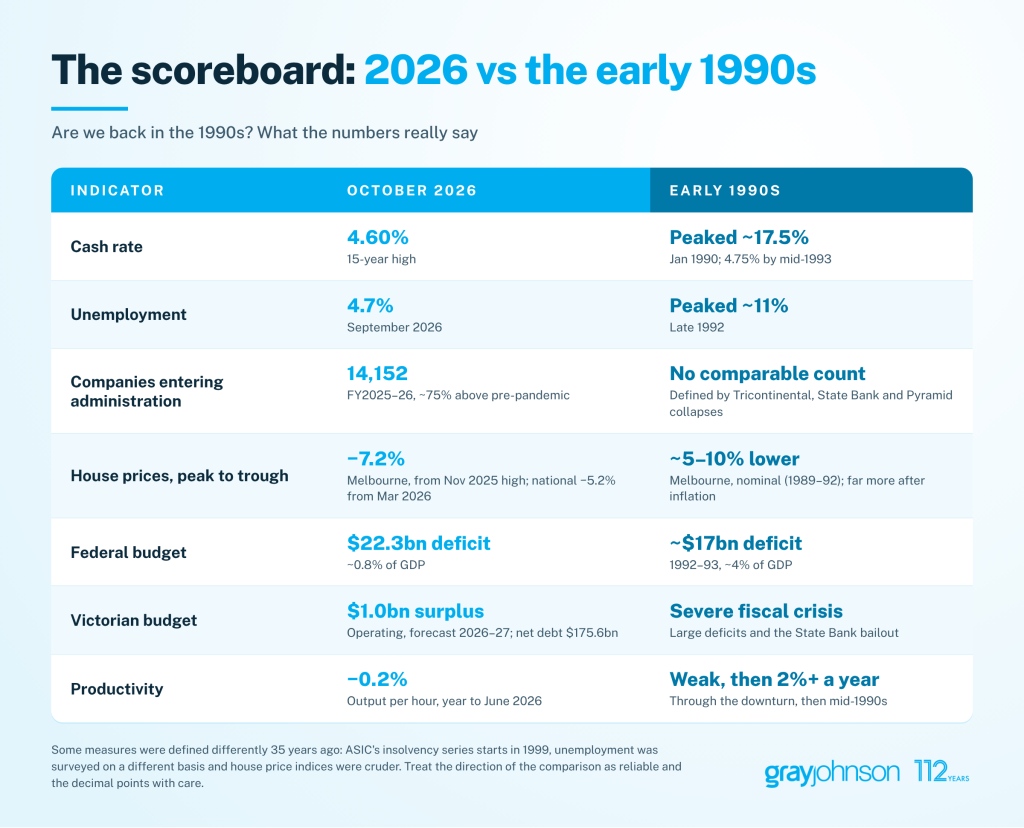
The verdict: tight, but not 1991
On the two numbers that defined the early 1990s, interest rates and jobs, we are nowhere near. The cash rate is about a quarter of its 1990 peak. Unemployment is less than half the 1992 high. The federal deficit as a share of the economy is a fifth of what it was. And Victoria, for all the noise about its debt, is forecasting an operating surplus rather than nationalising a failed bank.
But two measures are arguably worse than the 1990s, and they are the ones that matter most to commercial property.
The first is business failure. More than 14,000 companies entered administration last financial year. The 1990s had bigger names falling, but today’s failures are broader and quieter: cafes, builders, small manufacturers and retailers squeezed by holding costs, wages, land tax and customers with less to spend.
The second is productivity. Output per hour fell over the year to June. The economy came out of the 1990s recession on the back of a productivity surge of more than 2 per cent a year. There is no sign of that engine turning over yet, which is the main reason this downturn feels so grinding even without a spike in unemployment.
Melbourne house prices, meanwhile, have already fallen by about as much as they did between 1989 and 1992 in nominal terms, and several economists are forecasting a national peak-to-trough fall of 9 to 13 per cent.
Do our kids have it tougher?
Yes and no, and the split is instructive.
On jobs, no. A 25-year-old in 1992 faced an unemployment rate of 11 per cent and youth unemployment closer to 20. Today’s graduate has a far better chance of being employed and staying employed.
On housing, yes, and it is not close. The 1990 buyer paid 17 per cent interest on a home that cost around three to four times household income. Today’s buyer pays a fraction of that rate on a home that costs, in Melbourne, closer to eight or nine times. A rate cut helped the 1990s buyer enormously; it does far less for someone whose problem is the size of the loan, not the price of it.
That is the real difference between the two eras. The 1990s was a crisis of income. This is a crisis of balance sheets.
What it means for commercial property
The early 1990s commercial property crash was built on oversupply. Melbourne’s CBD office vacancy climbed past 25 per cent as towers financed on 1980s credit came out of the ground into a recession, and capital values roughly halved. It took most of the decade to absorb the space.
Today’s pressure comes from a different direction. There is no equivalent speculative construction boom; if anything, the pipeline has thinned because projects don’t stack up at current build and funding costs. The strain is coming from two places: the cost of debt, and the health of tenants.
For investors, we read that as follows:
Tenant quality is the asset. In a year with 14,000 insolvencies, the covenant matters more than the yield. A well-located asset leased to a struggling tenant is a riskier proposition than a secondary asset leased to a business that will still be trading in 2029. Due diligence on the tenant’s books is now as important as the building report.
Holding costs are doing what interest rates did in 1991. Land tax, insurance, compliance and rates are squeezing both landlords and tenants and are pushing independent operators out of strips that have housed them for decades. Investors need to model those costs honestly, because they are not cyclical in the way interest rates are.
Values are repricing, not collapsing. The 1990s saw forced sales into an empty market. Today we see patient vendors, cautious buyers and a widening gap between prime and secondary. That gap is the opportunity for buyers who can fund at current rates and hold for five years.
Rates will fall before confidence does. In the 1990s the cash rate fell from 17.5 to 4.75 per cent over three years and property still took most of the decade to recover, because jobs and confidence lag. Expect the same pattern now in miniature: the first cuts will help borrowers before they help values.
Where we are on the cycle
Our reading is that Melbourne is through the peak and somewhere past the midpoint of the correction, but not yet at the bottom. The indicators that fall first, prices and sentiment, have fallen. The indicators that mark a bottom, a stabilising insolvency count, a turn in productivity and the first sustained rate cuts, have not yet arrived.
That puts us roughly where the market was in late 1991: past the shock, not yet at the recovery, and with the best buying still ahead for those who are prepared.
The lesson of the 1990s is not that the sky fell. It is that the investors who did best were the ones who bought well-tenanted property from tired vendors in 1992 and 1993, when everyone else was still reading the headlines. The headlines today are loud. The numbers are more measured. We will keep watching both.